
Building the Future of Work with People at the Core
 SFG•
SFG•
An overview of key legal issues HR professionals need to be aware of. Staying compliant with employment laws and regulations is a critical responsibility for HR professionals.
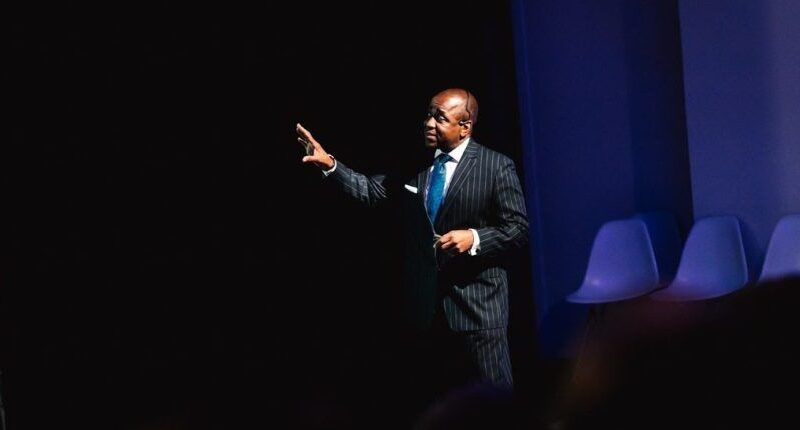
The Power 5: Global CHROs Redefining HR in 2025
“Leadership is not a position; it is a practice. Workforce strategy is business strategy.”
These guiding principles have shaped the career of a global HR leader who has spent decades reimagining the role of human resources, not as an administrative back-office function, but as the very architecture behind organizational transformation. From New York to Riyadh, Dubai to Singapore, Ron Thomas’s journey reflects a steadfast belief that the future of business is written in its people.
Professional Journey: Inspiration and Evolution
The earliest steps into human resources were not driven by process, but by people. Entering the field in New York, at a time when disruption was the constant rather than the exception, proved to be a crucible. At Martha Stewart Living Omnimedia, serving as Vice President of HR, he encountered the challenge of steering talent strategy within a creative-driven, globally recognized brand. It was here that one truth became undeniable: HR must transcend compliance. It must be strategy in action.
The next chapter unfolded in Riyadh, where he took on the role of CHRO at Al Raha Group. The business environment was dynamic, with a rapidly diversifying portfolio that demanded foresight, agility, and cultural cohesion. Aligning workforce strategies to business expansion meant anticipating capability gaps before they stalled growth, constructing leadership pipelines across unfamiliar markets, and designing cultural alignment across multiple entities.
Later, as CEO of Great Place to Work-MENA, he championed the belief that organizational success is inseparable from employee engagement and culture. Today, as Managing Director of Strategy Focused Group, with hubs in Dubai, New York, and Singapore, he continues to partner with executives across the globe, aligning people strategy with business transformation and ensuring HR remains at the center of organizational design.
Lessons from Global Experience
Operating across continents has been both an education and a proving ground. Each region offered its own lessons, shaping a global HR philosophy that is adaptive yet unified in vision.
United States instilled the value of meritocracy and speed, where accountability and clarity drive performance.
Middle East illustrated transformation at a national scale, where initiatives like Saudi Arabia’s Vision 2030 and Dubai’s ambitious expansion highlight workforce strategy as a vehicle for nation-building.
Asia-Pacific reinforced resilience, where long-term workforce planning and continuous learning outweigh quick fixes.
Europe emphasized balance, with its focus on social partnership, sustainability, and HR’s broader societal role.
“Strategy must always be localized, but ambition is universal,” he reflects. “Whether in Riyadh, Singapore, or Frankfurt, people everywhere share a common desire: to matter in the larger story of their organization.”
Challenges in Leadership and Talent Development
Across boardrooms worldwide, familiar echoes resound. The challenges may take different forms, but the themes are universal.
Succession readiness is too often misunderstood as a list of names rather than a true leadership pipeline. Readiness is not replacement. It is resilience.
Change fatigue undermines even the best digital transformations. Technology rarely fails. Cultures do, when people reach saturation.
Employee experience has shifted from transactional contracts to expectations of meaning, autonomy, and growth. Retention now rests on experience, not tenure.
“Organizations that ignore these dynamics don’t just risk losing talent,” he warns. “They risk losing their competitive edge.”
The Skills Future Leaders Must Master
Looking ahead, three capabilities stand as non-negotiable for the leaders of tomorrow.
Agility of thought and action: The ability to move decisively, even when certainty is elusive. Waiting for perfect information is no longer an option.
Workforce architecture: Aligning roles, skills, and organizational structures to strategy. It is the blueprint that underpins agility.
Empathetic communication: Trust is the currency of leadership. In uncertain times, leaders who communicate authentically will always inspire followership.
HR as the Architect of Transformation
The role of HR has evolved dramatically. Once considered administrative, it is now the execution engine of strategy. This shift has defined much of his work.
In Dubai, he collaborated with tourism authorities to forecast and build workforce capacity for future visitor surges. In financial services, he aligned digital transformation initiatives with the human capabilities required to deliver them.
“The message to CEOs is clear,” he emphasizes. “If HR is not at the table, your strategy is incomplete.”
Technology, AI, and the Human Element
While technology has become indispensable, it remains a tool, not a replacement. Artificial intelligence can write job descriptions, analyze employee sentiment, and forecast attrition. Yet, it cannot replicate empathy, judgment, or the human spark that drives culture.
“The most effective HR leaders use AI as an amplifier,” he explains. “It reduces administrative weight, freeing leaders to engage in the truly human work of coaching, mentoring, and guiding culture. The challenge is to integrate AI without losing humanity.”
Transformation in Action: A Success Story
One regional bank exemplifies this approach. Struggling with declining engagement, high turnover, and stagnant leadership pipelines, the organization sought a reset.
Through a Strategic Workforce Planning framework, critical roles were segmented, career progression aligned with business priorities, and leadership coaching introduced to shift executive behaviors.
Within just 18 months:
– Engagement scores rose by 23%.
– Attrition in key roles was halved.
– Growth initiatives accelerated, with measurable gains in new market penetration.
“The CEO later reflected: ‘We thought we were doing HR transformation. What we achieved was business transformation.’”
Cultural Diversity as a Source of Innovation
In an interconnected world, managing diversity is not about tolerance. It is about translation. Effective leaders:
– Build local champions to interpret strategy in a cultural context.
– Listen deeply, resisting the temptation of a headquarters-first mindset.
– Create flexible frameworks that honor variation while preserving unity of purpose.
“Cultural difference is not a challenge to fix. It is an innovation wellspring when harnessed.”
Mentorship and Coaching the Next Generation
Mentorship has been a defining thread in his career. “Careers are not linear highways. They are detours, U-turns, and scenic routes,” he often reminds mentees.
This philosophy also inspired the award-winning “The CEO Series with Ron Thomas” podcast on YouTube, a platform designed to provoke thought and share insights with aspiring leaders.
His approach to mentoring is rooted in:
– Provocative questioning to expose blind spots.
– Modeling vulnerability by sharing not just successes, but failures.
– Global exposure through projects and platforms that expand horizons.
“Mentorship isn’t about cloning leaders,” he says. “It is about cultivating authenticity.”
The Trends Defining the Next Decade
Looking to the future, he outlines several trends that will reshape HR more profoundly than the past half-century.
– AI-first HR strategy: From generative AI in recruitment to predictive analytics in retention, fluency in AI is a board-level requirement.
– Hybrid workforce ecosystems: The blend of employees, gig workers, contractors, and AI agents will define the workforce.
– Employee experience as strategy: Workplaces must be cultivated like gardens, where engagement grows in fertile soil.
– Middle East as a laboratory: Mega-projects such as Saudi Arabia’s NEOM or Dubai’s aviation expansion will serve as case studies in workforce design at scale.
– Sustainability of work: Green transitions and demographic shifts will reshape skills and mobility on a planetary scale.
Advice to Young HR Professionals
His message to the next generation is both simple and profound: “Stop chasing titles. Chase impact.”
He expands:
– Learn the language of business. Financial fluency is essential for credibility in the boardroom.
– Invest in analytics. Data is the currency of modern HR.
“The world needs HR professionals who think like strategists and act like entrepreneurs.”
Personal Motivation and Guiding Principles
Despite decades of leadership and recognition, what drives him is the unfinished business of HR. Too often, the profession remains underestimated, confined to process rather than recognized as strategy.
Each keynote, consulting project, and workshop is a chance to reframe HR’s value. His fuel comes from:
– Witnessing transformation when organizations unlock leadership potential.
– Teaching global classrooms, from Dubai to Washington, engaging with students hungry for relevance.
– Curiosity, which he sums up in a mantra: “When was the last time you did something for the very first time?”
At the heart of his philosophy is a conviction: “Leadership is not a position. It is a practice.” Influence is not granted by title, but earned daily through listening, adapting, and inspiring.
Closing Note
Being recognized as one of The Power 5: Global CHROs Redefining HR in 2025 is more than personal achievement. It is a statement about the profession itself.
“HR is no longer a supporting actor. It is the architect of strategy,” he concludes. “My hope is that this recognition reminds leaders everywhere of that truth and inspires the next generation to step forward with courage and conviction.”