
Why the Next Great Institution Won’t Be a University or a Corporation
 SFG•
SFG•
Exploring how flexible work options can enhance employee satisfaction and productivity. They allow employees to better balance their professional and personal lives, leading to higher job satisfaction and productivity.
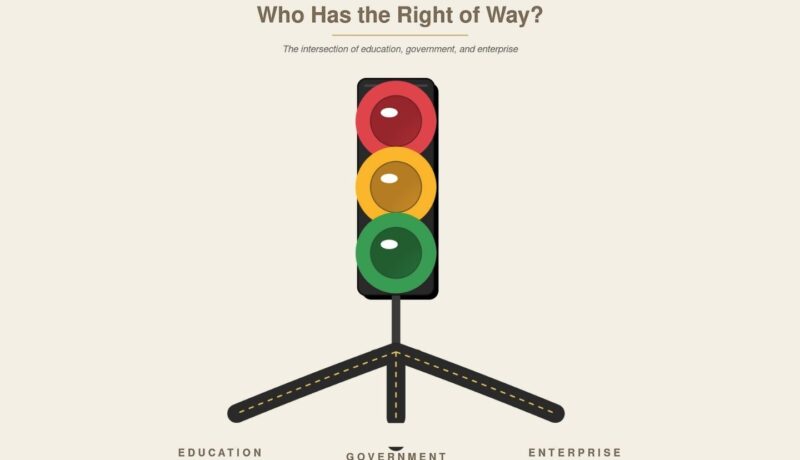
The intersection of education, government, and enterprise has arrived. There is no traffic light. And no one has the right of way.
This weekend, I sat in on an advisory board meeting at the Stirling Center for Strategic Learning & Innovation in Scotland. The agenda said the future of learning. What the room was actually wrestling with was something larger — and I have not been able to put it down since we adjourned.
I have been on enough boards to recognize when a conversation crosses from operational to existential. This one crossed. Around that table sat academics, practitioners, and strategists — all fluent in their domains, all honest about a truth we do not say often enough out loud: education, government, and enterprise have each been running their own race, and the race itself has changed.
The question that followed me out of that room is the one I want to put on the page while it is still hot. What happens to people when the institutions responsible for preparing them can no longer keep pace with the work they are being prepared for? The headlines this month have already started to answer.
When Oracle announced it was cutting 30,000 jobs, the headlines framed it as another round of AI-driven layoffs. The deeper story is the one no press release will tell you: the skills weren’t there. The work had already moved on. The people hadn’t.
Contrast that with IKEA. Facing the same AI pressure, they chose a different door. They reskilled. They kept the people and rebuilt the jobs around them — and reported a $1.4 billion revenue uplift with no layoffs. Two global companies, two diametrically opposed answers to the same question: one cut 30,000 jobs; the other added $1.4 billion in revenue without cutting anyone. And only one of those answers is scalable across an economy.
“The redundancy letter is the easiest leadership document in the world to sign. Reskilling is the harder one.”
The Oracle path is not just a corporate choice. It is a signal that large parts of our workforce have been outrun by their own tools, and that the institutions responsible for keeping people current have been building for a world that no longer exists.
We are heading into an intersection where there is no traffic light. Education, government, and enterprise are all accelerating toward the same crossroads, and each still believes it has the right of way. None of them do. And the longer we pretend otherwise, the worse the collision.
The Broken Elevator
“The elevator is broken, you have to take the stairs.”
For most of the past fifty years, the career elevator worked. You pressed “degree.” It lifted you to “entry-level.” You pressed “experience.” It lifted you to “management.” Institutions were the cables. Corporations were the floors. Governments regulated the building.
That elevator is broken. And no maintenance crew is coming.
Careers no longer rise in straight lines because work no longer moves in straight lines. A role that took four years to learn can be rewritten by agentic AI in a quarter. A skill that commanded a premium in 2023 is a commodity in 2026. The elevator assumed stability in the floors above you. There is no such stability now.
So we take the stairs. Step by step, pulsed, measured, rebuilt as we climb. And every landing forces the same question: do the dynamics of education, work, and skills still line up, or have they drifted again? Right now, they have drifted.
Three Legs, One Stool
This is where I lose patience with the standard discourse. Open LinkedIn any morning, and you will find a hundred posts on “5 Steps to an AI Strategy” or “10 Leadership Hacks for the Future of Work.” My eyes roll. Not because those topics are wrong, but because they are fragments of a conversation we are refusing to have at the level it needs to happen.
The real conversation is an adult one. And it is not a corporate conversation, or an academic conversation, or a policy conversation. It is all three, in the same room, at the same table.
Governments set the rules of the labor market, the funding of public education, and the safety net that catches people between transitions. Educational institutions decide what a credential means, what a graduate can do, and how quickly the curriculum can move. Corporations decide what work gets automated, what work gets augmented, and what work gets eliminated entirely.
Each leg depends on the other. Remove anyone, and the stool collapses under the weight of a workforce too large to retrain in the timeframe the market is giving us. This is not a competitive analysis. This is infrastructure — infrastructure for future generations. And infrastructure is not built by any single player, no matter how well-resourced.
The Signals Are Already Here
Look at the signals on the ground. The Los Angeles Times recently reported that a wave of colleges is shortening the bachelor’s degree from four years to three. On the surface, it is a cost story. Underneath, it is a confession: the old container no longer fits the content. By the time a traditional four-year graduate reaches the workplace, the skills that defined their discipline have been partially rewritten by AI.
That is not a problem to be solved with a better curriculum. It is a problem to be solved with a different operating model — one where education, work, and skills are continuously pulsed the way a physician pulses vitals in an annual physical. What a student learns on Monday is informed by what an employer implemented on Friday. What a government funds is informed by what a region will need three to five years out.
That is what strategic workforce planning actually looks like. Not manpower planning. Not headcount forecasting. Not a rebranded HR exercise. It is an honest view of what the workforce must become, and a disciplined build toward that future state — across all three legs of the stool at once.
The Next Great Institution
So what is the next great institution?
It is not the university, reformed. It is not the corporation, reinvented. It is not the ministry, modernized.
It is the collaborative architecture that sits between them. The shared pipelines where regional universities feed regional employers. The governments that underwrite transitions rather than cushion failures. The corporations that commit to reskilling rather than reaching first for the redundancy letter. It is the standing forum, not the panel. The joint investment, not the press release.
We already know what fragmentation gets us: Oracle at one extreme, a handful of IKEAs at the other, and a large middle that is quietly shedding people faster than it is developing them. That middle is where the cliff is. And the cliff is closer than our dashboards suggest.
Connect the Dots — or Lose Them
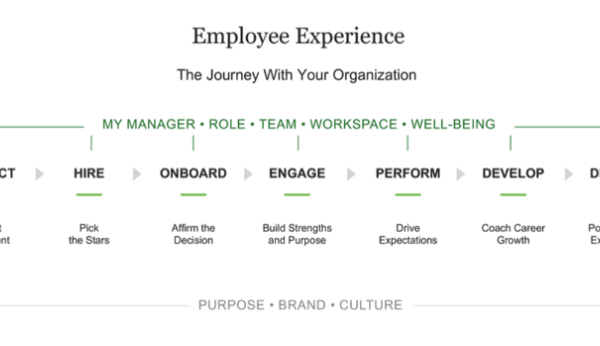
Organizations will keep talking about strategy, employee experience, wellness, engagement, and leadership. All of it matters. None of it matters enough on its own. Until we step back and connect the dots between what we teach, what we govern, and what we build, the approach will stay fragmented, and the outcomes will stay disappointing.
The intersection is here. There is no traffic light. And nobody has the right of way.
The next great institution will be the one brave enough to direct the traffic. This morning, I sat in a room of people trying to do exactly that. The work is real, the intent is serious, and the architecture is being drawn. We now need many more of those rooms — and we need them talking to each other before the intersection decides for us.
Click here for more articles with Ron Thomas.